
The Mumbai police were on high alert after an X user @ffsfir wrote a post about the potential threat which reads like "My mind is wondering shamelessly that half the world would go upside down tomorrow after a bomb went off at the Ambani wedding. trillions of dollars in one pin code."

Among the Sensex stocks, JSW Steel, Asian Paints, Maruti Suzuki India, NTPC, Adani Ports and Special Economic Zone, Bharti Airtel, ITC and Tech Mahindra were the major gainers. Reliance Industries, Tata Motors, Infosys, Mahindra and Mahindra, Bajaj Finance and Axis Bank were the laggards.

Roughly 40% of this projected outlay is expected to go towards emerging industries, including green hydrogen, clean energy, semiconductors, and electric vehicles.

Many Dharmagurus attended the Shubh Ashirwad ceremony.

Quarterly earnings of corporates, trading activity of foreign investors and inflation data are the key factors that are expected to drive the momentum in the equity markets this week, analysts said.

Among the Sensex pack, HDFC Bank, ICICI Bank, Kotak Mahindra Bank, Bajaj Finance, IndusInd Bank, Bharti Airtel and Nestle were the biggest gainers. Tata Consultancy Services, Sun Pharma, Infosys and Tata Motors were among the laggards.
Three different invitations were sent out for the wedding and the receptions with top-run guests being sent a large red box that contained an intricate chest incorporating a mini silver temple featuring gold idols of various Hindu deities, including Lord Ganesh, Radha-Krishna, and Goddess Durga.

Share prices of Nestle India, Asian Paints, Bandhan Bank, Tata Technologies, AU Small Finance Bank and Avenue Supermarts, all a part of the BSE 500 index, have hit their respective 52-week lows on the BSE in Thursday's intra-day trade after a sharp correction in the equity markets.
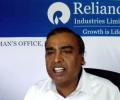
Reliance Industries Ltd on Monday reported an almost flat March quarter net profit, amid a recovery in its core oil and petrochemicals business and sustained momentum across the consumer-facing telecom and retail businesses. RIL's net profit stood at Rs 18,951 crore, or Rs 28.01 per share, in the January-March quarter of the 2023-24 fiscal as compared to Rs 19,299 crore, or Rs 28.52 a share, a year ago, according to a company's stock exchange filing.

Ambani won unanimously with 100 per cent of vote at the 142nd IOC session in Paris.

Billionaire Mukesh Ambani-led Reliance Industries has completed the merger of its media assets with the India business of global media house Walt Disney and formed a joint venture with a valuation of over Rs 70,000 crore. The JV will be one of the largest media and entertainment companies in India with a combined revenue of approximately Rs 26,000 crore and will be led by Nita Ambani as its chairperson, according to a joint statement.

Recouping the dent caused by the Hindenburg Research report, Gautam Adani's networth shot up 95 per cent to Rs 11.6 lakh crore last year, which helped him replace Mukesh Ambani to become the richest Indian, a report said on Thursday. Reliance Industries chairman and managing director Ambani's overall networth increased by 25 per cent to Rs 10.14 lakh crore, as per the 2024 Hurun India Rich List. In 2023's report, Adani's wealth declined by 57 per cent to Rs 4.74 lakh crore, and Ambani was way ahead with a fortune of Rs 8.08 lakh crore.

Unprecedented bribery charges, farewells, separation, failed union, monumental mergers and record-breaking IPOs, along with a healthy dose of online happenings in the form of spat and lessons in customer care, corporate India saw it all in 2024.

Among the 30 Sensex companies, IndusInd Bank, Axis Bank, ICICI Bank, Bharti Airtel, Kotak Mahindra Bank, Maruti, JSW Steel and Bajaj Finserv were among the laggards. In contrast, Reliance Industries, Tata Motors, Asian Paints, Nestle and Titan were the biggest gainers.

At the start of the auction on Sunday, Punjab Kings had the highest funds at Rs 110.5 crore, which decreased to Rs 10.9 crore before Day 2 on Monday.

India's thriving mutual fund (MF) industry is drawing interest from several firms, with multiple applications submitted to the Securities and Exchange Board of India (Sebi) for asset management company (AMC) licences.

Reliance Industries was the biggest gainer in the Sensex pack, rising 2.69 per cent, followed by HCL Tech, ICICI Bank, Tata Motors, Wipro, IndusInd Bank, JSW Steel, Wipro, Tata Consultancy Services and Titan. In contrast, NTPC, Power Grid, UltraTech Cement, Axis Bank, Infosys and Nestle were the major laggards.

Reliance Industries in collaboration with The Oberoi Hotels and Resorts will co-manage three iconic hospitality projects which include Anant Vilas in Mumbai and Stoke Park in the UK, the company said on Thursday. The arrangement between the two companies also includes management of another planned project in Gujarat. "Reliance Industries...has entered into an understanding with The Oberoi Hotels and Resorts (Oberoi) to jointly manage three properties across India and the UK.

After three cheetahs died in just over a month last year in Madhya Pradesh's Kuno National Park, the National Tiger Conservation Authority in May 2023 called in experts from Reliance's wildlife facility in Gujarat to review health monitoring protocols, official records show.
India Inc has reported a muted start to the financial year 2024-25, with a decline in net earnings and a modest single-digit uptick in revenues. An analysis of 488 companies that have released their results for the June 2024 quarter reveals a 1.6 per cent year-on-year (Y-o-Y) drop in combined net profit -- the weakest performance in the past seven quarters. In stark contrast, the combined net profit of these companies experienced a 13.6 per cent Y-o-Y increase in the previous quarter (Q4FY24) and a 65.2 per cent Y-o-Y rise in Q1FY24.

On a five-day rolling basis, FPI selling is the highest in 24 years.

Bharti Airtel on Monday reported a 168 per cent year-on-year rise in consolidated net profit to Rs 3,593 crore for the September quarter, and the company unveiled top-level changes, including Gopal Vittal moving into the role of executive vice chairman on January 1, 2026. India's second-largest telco - that competes with Reliance Jio and Vodafone Idea in the Indian telecom market - clocked quarterly revenues of Rs 41,473 crore, 12 per cent higher than the year-ago period, aided by strong momentum in India and growth in Africa.

Paramount Global has agreed to sell its 13 per cent stake in its Indian TV business to Reliance Industries for Rs 4,286 crore, the Indian firm said on Thursday. In a stock exchange filing, Reliance said it has signed a binding agreement with two subsidiaries of Paramount Global to acquire 13.01 per cent equity stake of Viacom 18 Media Private Limited held by Paramount Global. Similarly, in a filing on the US Securities and Exchange Commission (SEC), Paramount Global said the closing of the transaction is subject to the satisfaction of certain customary conditions, including receipt of applicable regulatory approvals, as well as the completion of a previously announced joint venture involving Reliance, Viacom18 and Star Disney.

Reliance Industries chairman Mukesh Ambani on Saturday received a threat email from an unidentified person seeking Rs 200 crore, the communication coming a day after another email threatened that he would be shot dead if he did not pay Rs 20 crore, a Mumbai police official said.

The pre-wedding festivities of Radhika Merchant and Anant Ambani aren't over yet!

The celebrations continued with the mehendi ceremony for Radhika Merchant and Anant Ambani.

Billionaire Mukesh Ambani on Thursday unveiled the next phase of growth at Reliance Industries Ltd, with retail and telecom worth over $100 billion each, doubling revenues and pre-tax profit in 3-4 years, new energy business becoming profitable by 2031, and core oil and chemical business continuing to be the robust growth engine. The sprawling conglomerate with interests in refining, oil and gas, petrochemicals, telecom, retail, and media is on track to more than double in size before the end of the decade, Ambani, chairman and managing director of Reliance, told company shareholders.
Shares of Mukesh Ambani-owned Reliance Industries Limited (RIL) rose nearly 1 per cent on Tuesday, hitting an intraday high of Rs 2,986.05 per share, after most brokerages reacted positively to the company's March quarter (Q4FY24) results. The bullish outlook stems from Reliance Jio's potential tariff hikes, given the competitive landscape, along with slow but steady improvement in the oil-to-chemical (O2C) vertical.

Reliance Industries Ltd, India's most valuable company, on Friday reported a 5 per cent drop in its June quarter net profit as lower fuel cracks and petrochemical margins outdid gains in telecom and retail businesses. The oil-to-retail-to-telecom conglomerate's consolidated net profit was at Rs 15,138 crore, or Rs 22.37 per share, in April-June -- the first quarter of the current 2023-24 fiscal year -- compared to Rs 16,011 crore, or Rs 23.66 a share, earnings a year back, according to a company's statement.

The merger and acquisition (M&As) transactions have picked up pace in the March quarter of 2024 with 455 deals amounting to $25.6 billion deal value announced. This is a 24 per cent rise in deal volume as compared to Q4CY23, according to PwC India report. This signals a shift from the declining trend observed in 2023, as per PwC India's report Deals at a glance.

According to the spokesperson, Singh has filed a police complaint and the FIR has been lodged for further investigation by the cyber crime cell.

'What is Balaji without Ekta (Kapoor), what is Dharma without Karan (Johar?)'

Industry experts believe that this deal will positively impact the Indian film industry, which is struggling with fewer movie releases.

For the past few days, Tata had been admitted to the Breach Candy Hospital in south Mumbai.

From the Sensex basket, Infosys, IndusInd Bank, Bajaj Finserv, Wipro, HCL Technologies, Bajaj Finance, Tech Mahindra, Tata Consultancy Services, and Larsen & Toubro were the major laggards. Titan Company, Hindustan Unilever, HDFC Bank, Maruti, ITC, Power Grid and Reliance Industries were the gainers.

India's export of fuels like diesel to the European Union jumped 58 per cent in the first three quarters of 2024, with a bulk of them likely coming from refining discounted Russian oil, according to a monthly tracker report. The EU/G7 countries in December 2022 introduced a price cap and an embargo on the imports of Russian crude oil in a bid to cripple Kremlin's revenue and create a vacuum in its funding for the invasion of Ukraine.

The Ministry of Heavy Industries announced on Tuesday that it has received bids from seven players for the re-bidding tender of the 10 gigawatt-hour (Gwh) tranche of the Advanced Chemistry Cell (ACC) manufacturing production-linked incentive (PLI). "The list of bidders (in alphabetical order) who have submitted bids in response to this tender are ACME Cleantech Solutions, Amara Raja Advanced Cell Technologies, Anvi Power Industries, JSW Neo Energy, Reliance Industries, Lucas TVS, and Waaree Energies for a cumulative capacity of 70 Gwh," the ministry said in a statement. After the re-auctioning for the manufacturing unit was announced in January, the pre-bid meeting was held on February 12, the ministry said.

Billionaire Mukesh Ambani's Reliance Industries and Tata Group have made it to the prestigious TIME's list of 100 World's Most Influential Companies of 2024. TIME called Reliance 'India's Juggernaut'. This is the second time that Reliance has found its way into the TIME list. Jio Platforms, the firm that holds digital properties of the conglomerate, was included in the inaugural TIME 100 Most Influential Companies List of 2021. Serum Institute is the other Indian company on the list.

From the Sensex basket, Mahindra & Mahindra, Maruti, Tata Steel, Bajaj Finserv, Power Grid, Reliance Industries, Axis Bank and JSW Steel were the major gainers. Wipro, Nestle, HDFC Bank and Bajaj Finance were among the laggards.

Much of the discussion is happening at a "family level, not a corporate level". That means it is an Ambani or a Goenka in direct talks with Johar.
